Exercises / Squat
How to squat: proper form and 4 common mistakes
Sit your hips back and down with your feet planted, knees following your toes and your back in its natural line, then stand back up.
Good form
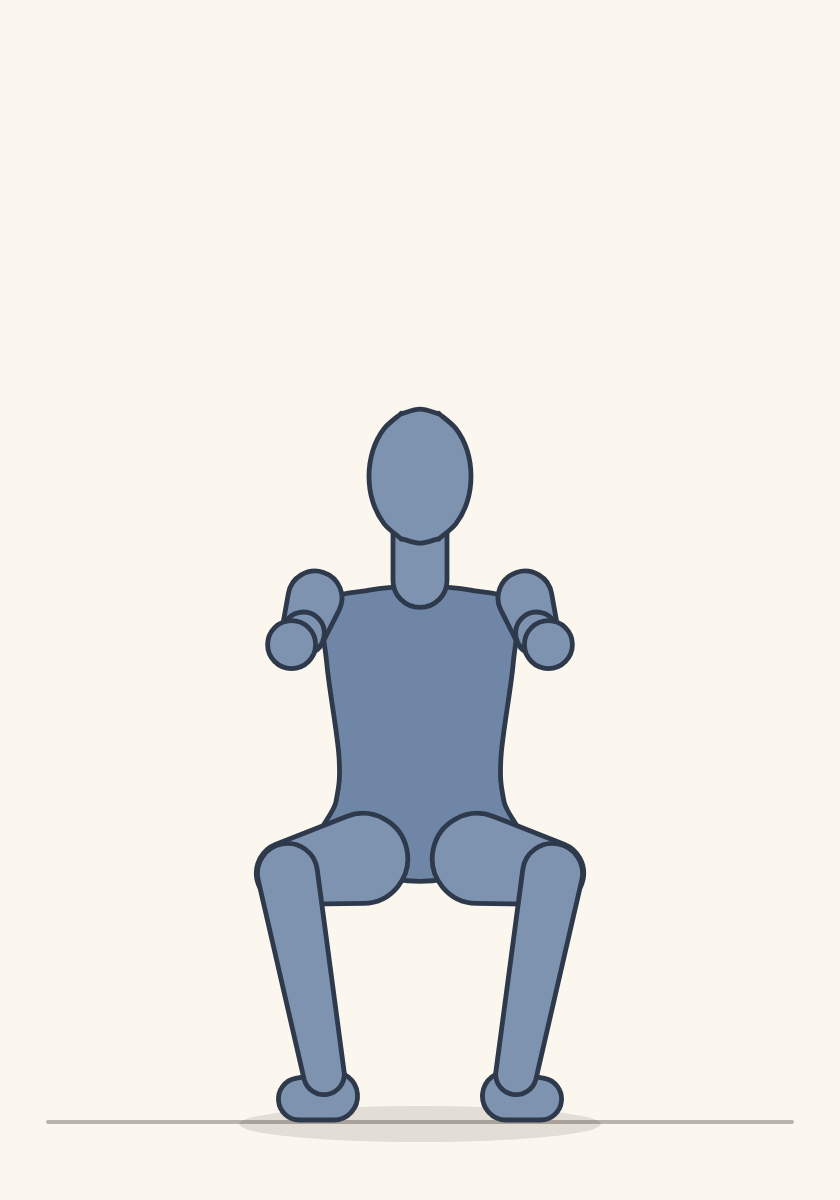
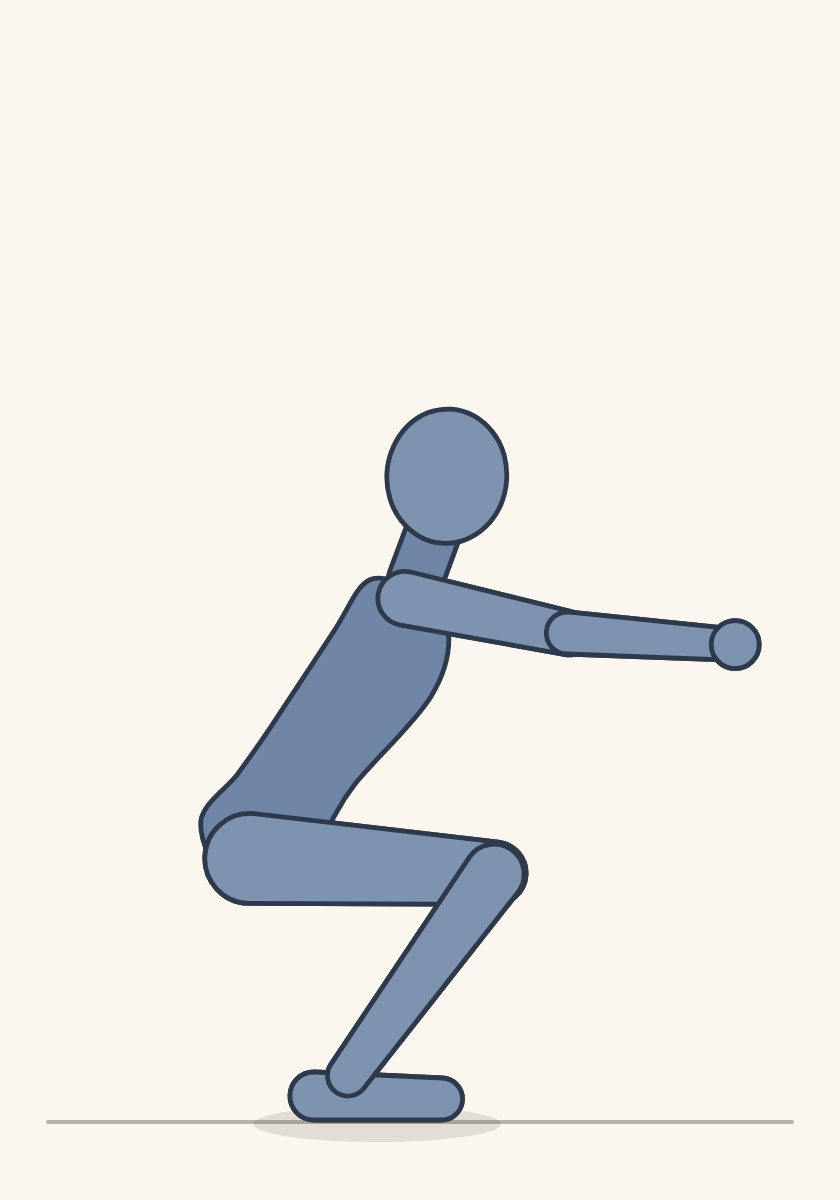
- Feet about shoulder width apart, toes turned out a little.
- Sit your hips back and down, as if reaching for a chair behind you.
- Knees follow your toes the whole way down and up.
- Keep your back in its natural line and your chest about parallel to your shins.
- Heels stay down. Push the floor away to stand up.
Knees caving in
As you go down or stand up, your knees drift toward each other and end up inside the line of your feet.
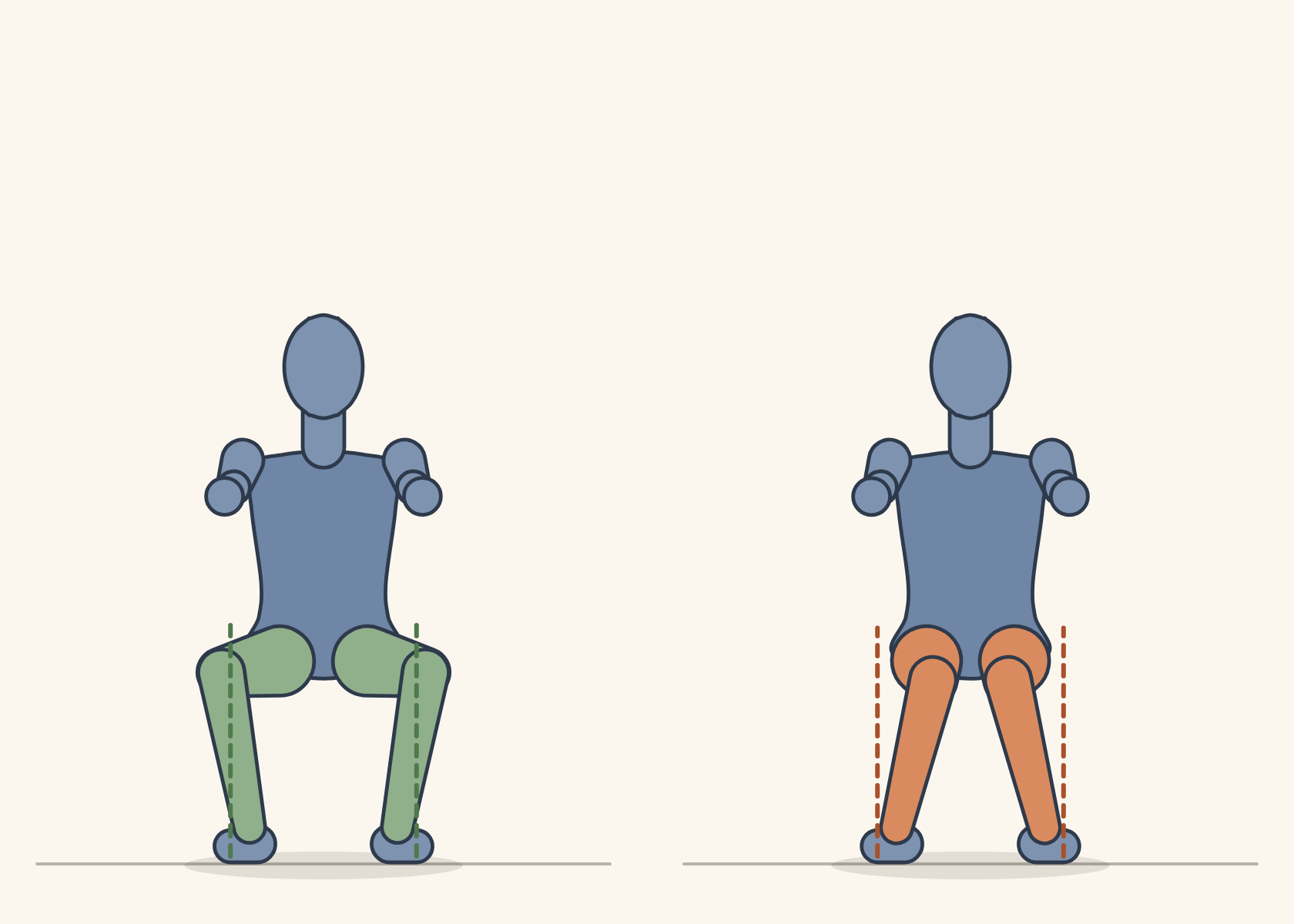
See it from the three-quarter
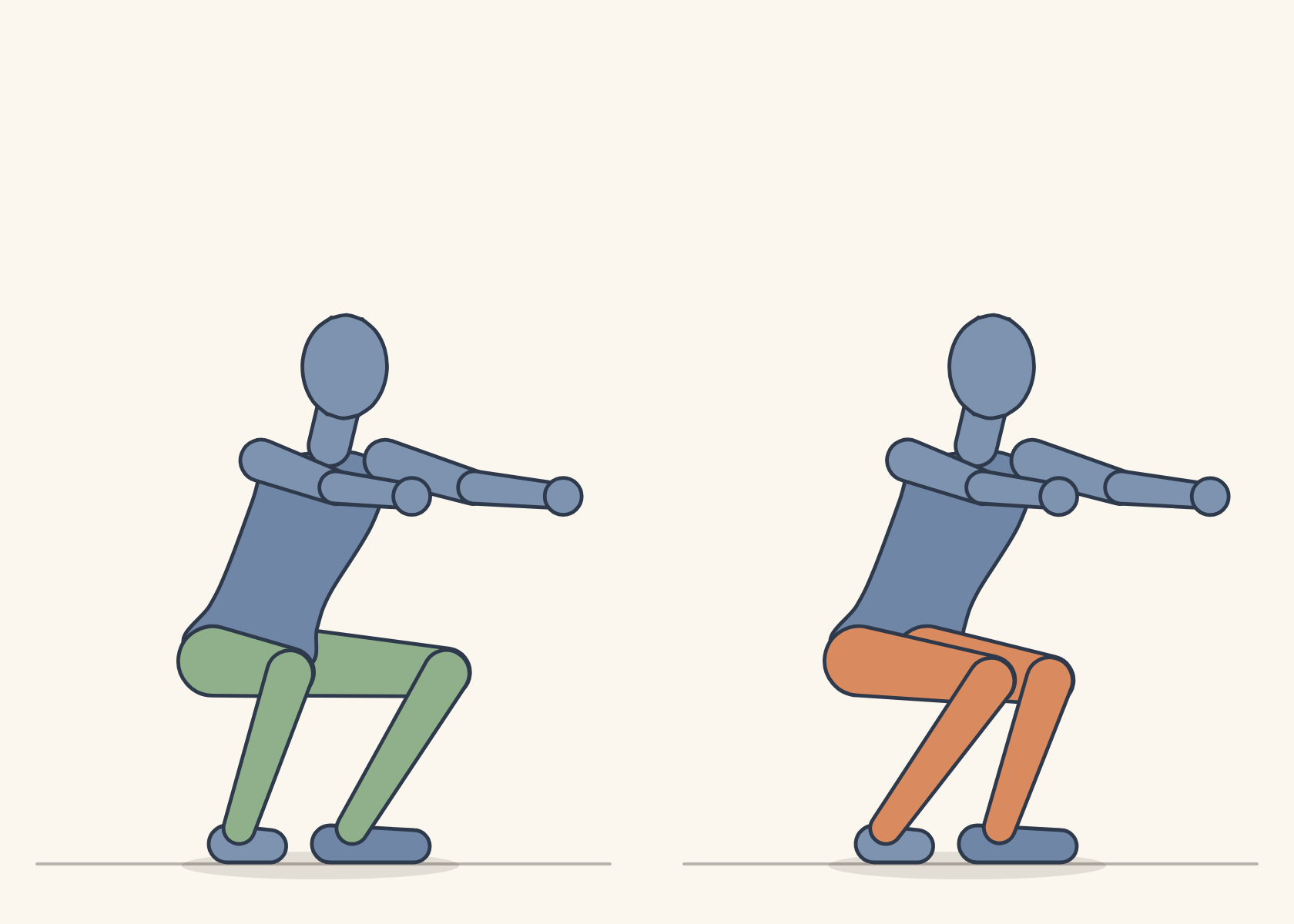
Right away
- Your knee drifts out of line with your hip and foot. Poor control at the hip and trunk can change how the knee moves and takes load.1
Over months and years
- Knees that angle inward are linked with a higher chance of pain at the front of the knee. In one study of military recruits, those whose knees angled in more during single-leg landings were about twice as likely to develop it.2
- In studies of female athletes landing from jumps, knees caving in under high load was linked with a higher risk of ACL tears.3
How to fix it
- Think "knees toward your pinky toes" and "spread the floor" with your feet.
- Put a light mini-band just above your knees and keep gentle tension on it the whole rep.
- A review recommends building glute strength, side-trunk strength and ankle mobility to reduce knees caving in. Easy places to start: side-lying leg raises, clamshells and banded side steps.4
- If your ankles are stiff, add the knee-to-wall ankle stretch (see heels lifting, below).
Easier versions while you learn
- Squat to a box or bench at a height where your knees stay over your toes.
- Slow it down: 3 seconds on the way down, watching your knees in a mirror.
See a doctor or physical therapist if
- Your knee hurts during or after squatting and it hasn't eased within a week or two.
- Your knee swells, locks, catches or gives way.
- The front of your knee aches on stairs or after sitting for a long time.
Heels lifting off the floor
Near the bottom, your heels peel up and your weight rolls onto the balls of your feet.
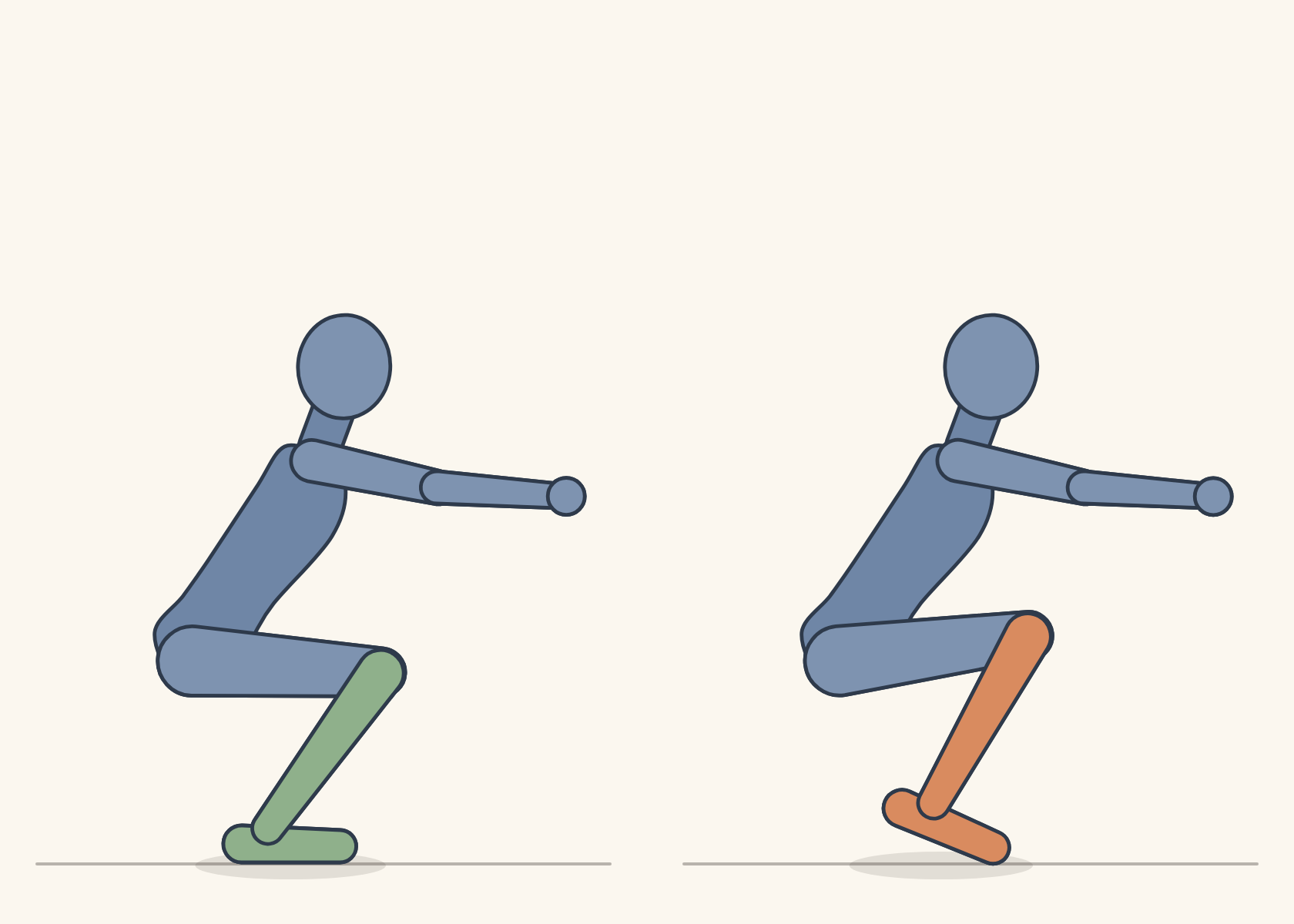
See it from the three-quarter
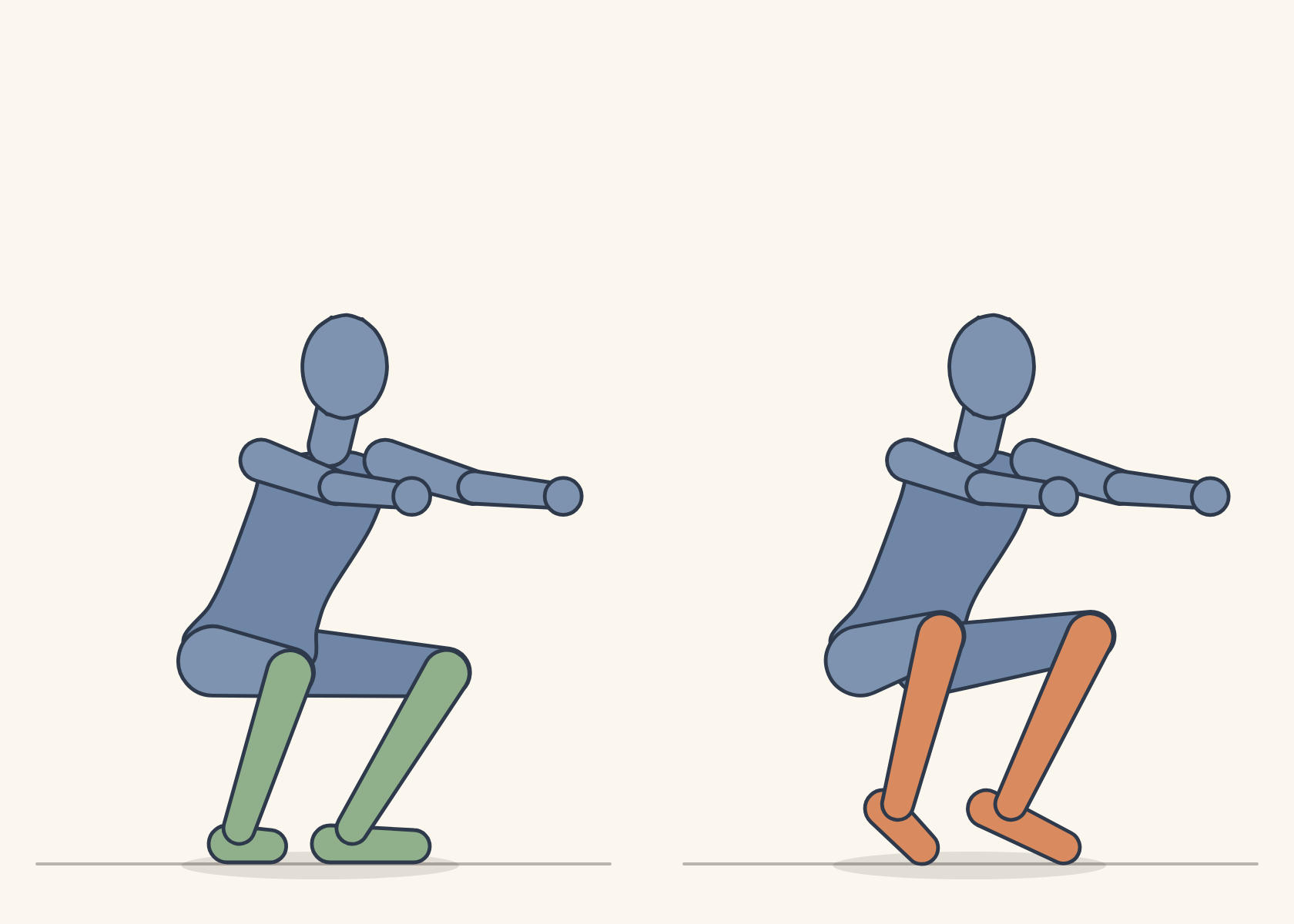
Right away
- Stiff ankles may play a part. In a lab study, limiting how far the ankles could bend during squats made the knees cave in more and the front thigh muscles work less.5
How to fix it
- Keep your weight over the middle of your foot. You should be able to wiggle your toes at the bottom.
- Knee-to-wall ankle stretch: foot a few inches from a wall, bend the knee forward to touch the wall with the heel down. 10 slow reps each side.
- Calf stretch against a wall, 30 seconds each side, with the back knee straight and then bent.
- While you work on your ankles, a small heel lift (about an inch) may help you squat deeper and more upright. Keep it small: too much lift may add work for the front of your thighs.7
Easier versions while you learn
- Only squat as deep as your heels stay down.
- Squat with your heels on a small plate (about 1 inch) while your ankle mobility improves.
See a doctor or physical therapist if
- One ankle is much stiffer than the other, or the stiffness started after an ankle sprain.
- You have pain at the back of your heel or along your Achilles tendon.
Lower back rounding at the bottom
Right at the bottom, your hips tuck under and your lower back curves (sometimes called "butt wink").
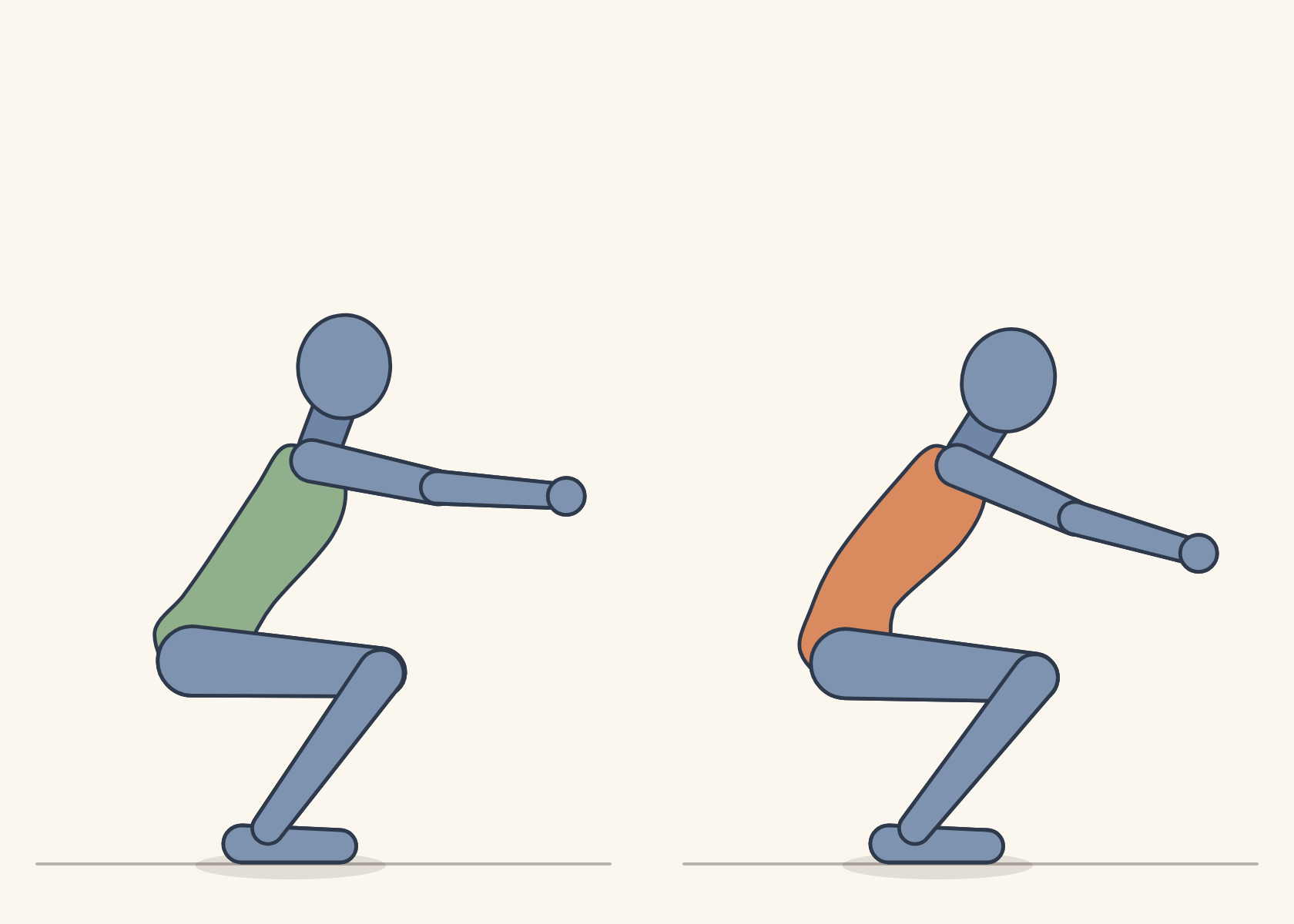
See it from the three-quarter
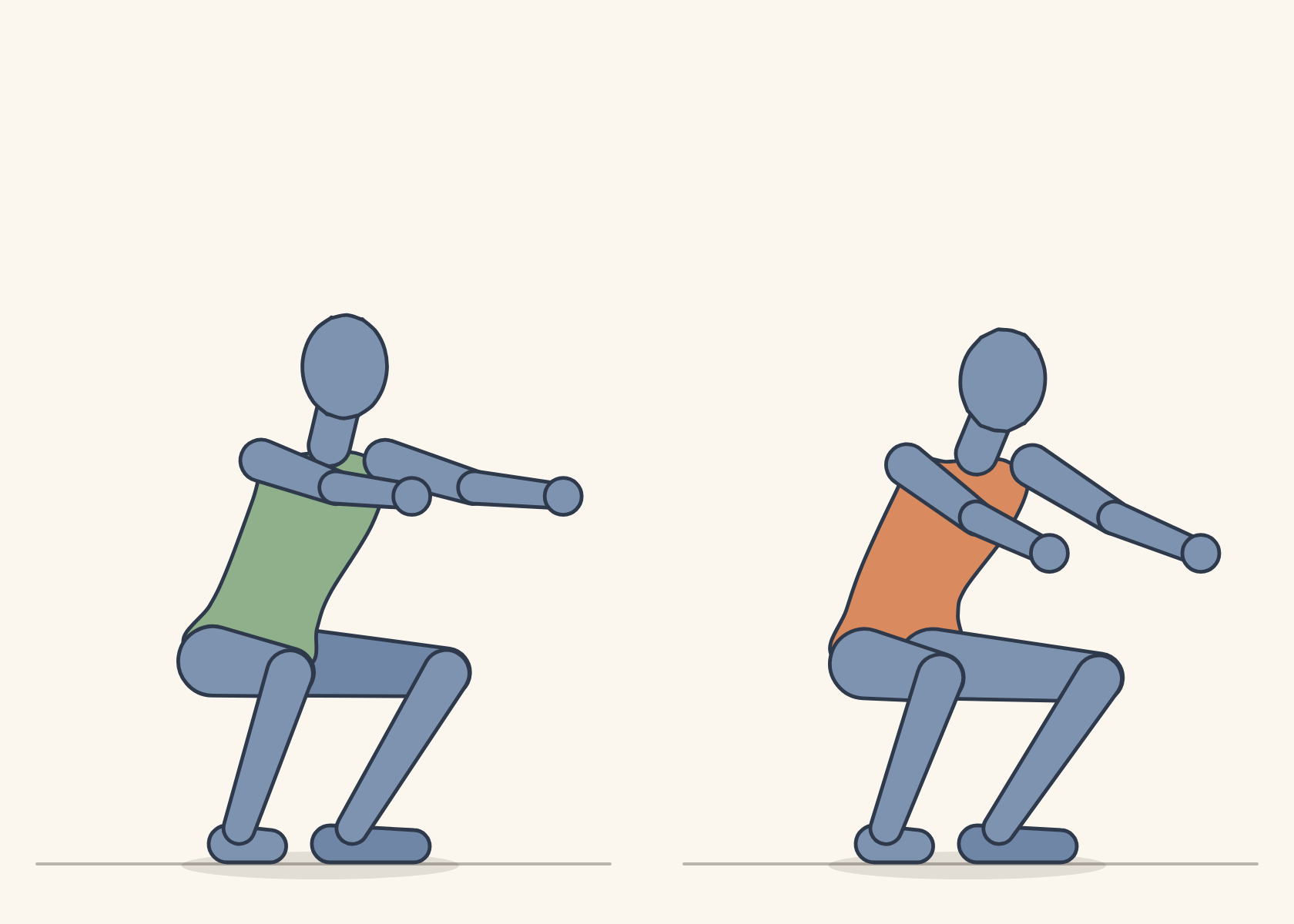
Right away
- When you lift a load from a rounded lower back, more of it tends to be carried by the spine itself while the back muscles do less. In a lifting study, the biggest loads went through a bent spine while those muscles were quiet.8
Over months and years
- In lab tests on animal spines, bending the spine over and over under load was linked with disc injury. How much that applies to people squatting is still debated.9
- Don't force the opposite extreme either: one modeling study favored a natural middle back position, where muscles and spine share the load.10
How to fix it
- Squat only as deep as you can keep your back's natural line. That depth is your bottom for now.
- Brace before you go down: breathe in, then tighten your stomach as if someone were about to poke it.
- Try a slightly wider stance with your toes turned out a bit more. It often gives your hips more room.
- Hold a light weight at your chest (a goblet squat). The counterweight makes it easier to sit down between your heels.
Easier versions while you learn
- Squat to a box set at the depth just above where your back starts to round.
- Pause for 2 seconds at that depth to learn where your bottom is.
See a doctor or physical therapist if
- Back pain spreads down a leg, or you feel numbness or tingling.
- Back pain doesn't ease within a couple of weeks, or it wakes you at night.
Chest dropping forward
Your chest falls toward your knees and your torso tips much further forward than your shins, often worst as you stand up.
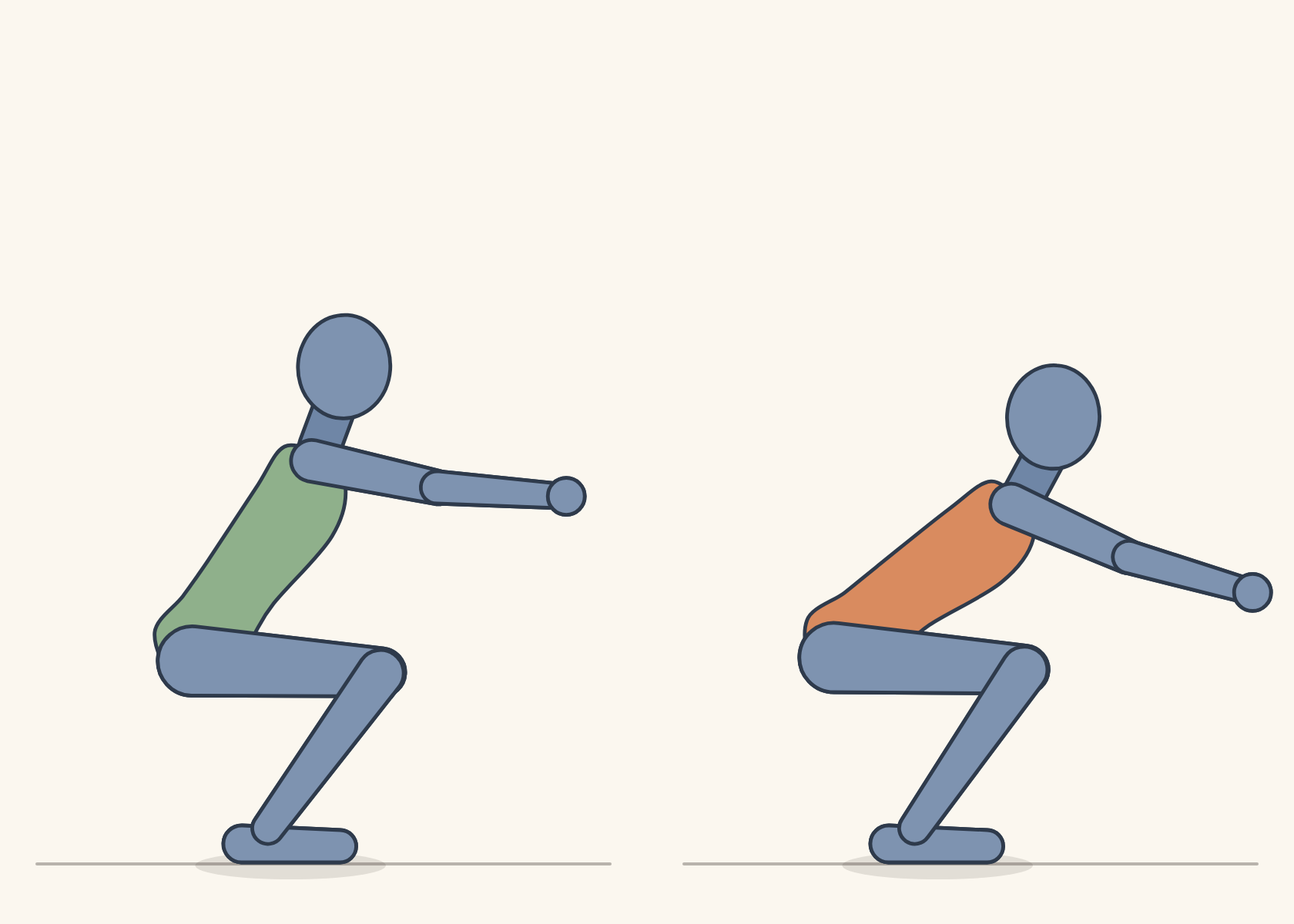
See it from the three-quarter
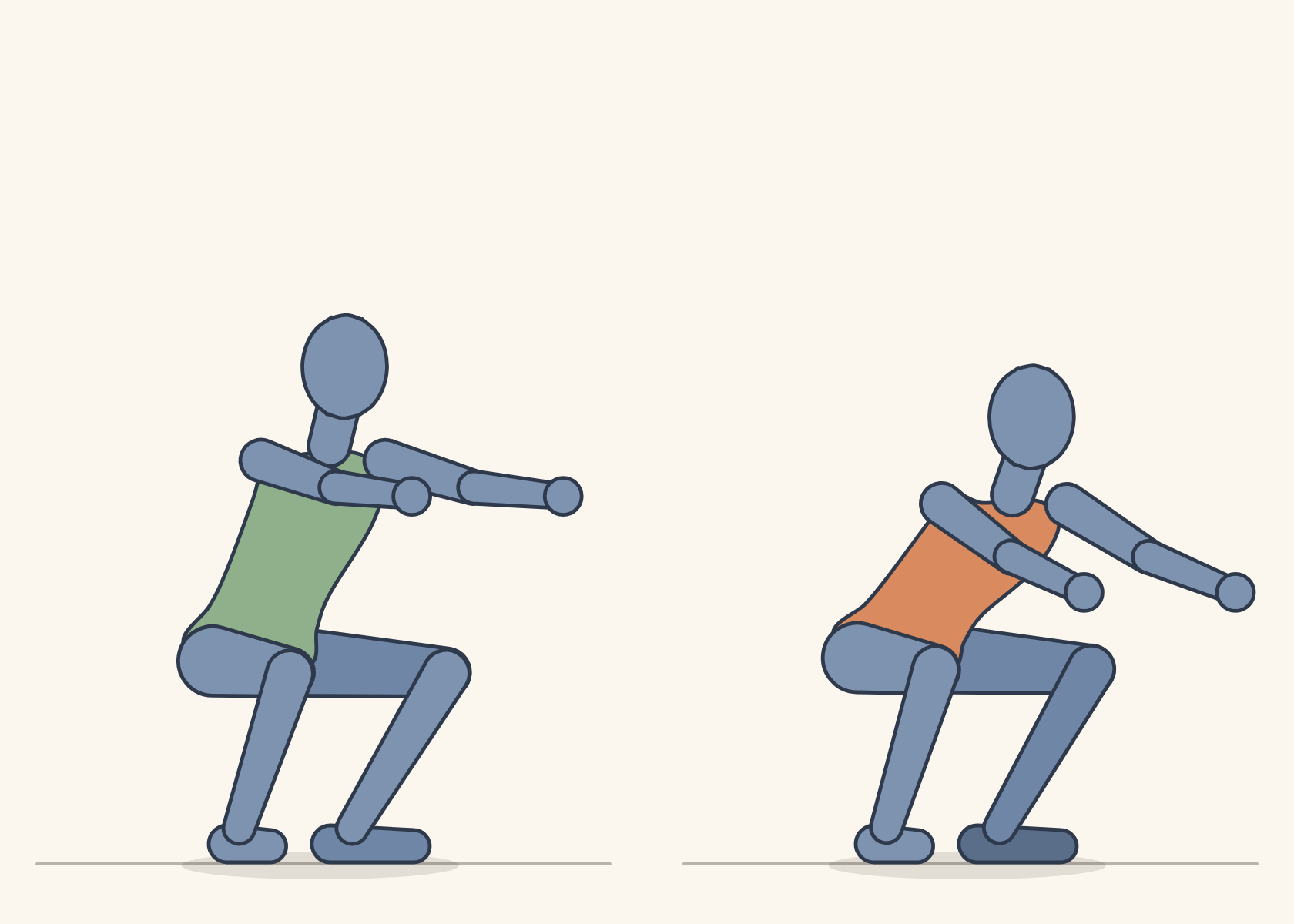
Right away
- Leaning further forward tends to shift more of the effort from your thighs to your hips.11
Over months and years
- With weight on your back, a more tipped-forward torso is linked with more demand on the lower-back muscles and more shearing force on the lower spine.12
How to fix it
- Chest proud: imagine showing the logo on your shirt to someone in front of you.
- Keep your torso about parallel to your shins at the bottom.
- Hold a light weight at your chest (goblet squat). It counterbalances you and keeps you more upright.
- A small heel lift may help you stay more upright while your ankles loosen up. Keep it small: too much lift may add work for the front of your thighs.7
Easier versions while you learn
- Squat to a box and pause sitting tall for a second before standing.
- Wall squat: face a wall a few inches away and squat without touching it.
See a doctor or physical therapist if
- Your lower back aches during or after squatting and it keeps coming back.
For trainers: how to cue it
- Watch the first rep from the front, the second from the side. Each of the four faults below shows best from one of those angles.
- Use outside-focused cues: "spread the floor" and "knees toward the pinky toes" usually land faster than naming muscles.
- A light mini-band just above the knees gives the client something to push against when the knees drift in.
- If a client can't fix a fault by cueing alone, lower the depth (a box or bench) before adding load.
Older adults: the safer version
A chair squat (sit to stand) trains the same movement with something solid behind you.
- Use a sturdy chair against a wall, and stand with a counter or sturdy table within reach.
- Feet flat, about hip width apart. Lean forward a little and slowly lower until you lightly touch the seat.
- Push through your whole foot to stand back up. Use your hands on your thighs or the counter if you need them.
- Start with 5 slow reps. Stop if anything hurts or you feel dizzy.
Questions people ask
Are deep squats bad for your knees?
For most healthy people, no. A review found deep squats don't add injury risk to the knee's passive tissues compared with shallower ones.13
Is it okay for my knees to go past my toes?
Letting your knees travel forward shifts more of the work to your thighs; keeping your shins upright and leaning more shifts it to your hips. Which suits you depends on your goals and any knee or back issues, so ask a trainer if you're unsure.11
How can I tell if my knees cave in?
Film a set from the front at about knee height. If your knees end up inside an imaginary line drawn straight up from your toes, they're caving in.
Want Vicky to watch your squat?
She coaches in person and online. Send a short video or a question and she'll reply herself.
Email VickySources
- The influence of abnormal hip mechanics on knee injury: a biomechanical perspective.
- Frontal plane projection angle predicts patellofemoral pain: Prospective study in male military cadets.
- Biomechanical measures of neuromuscular control and valgus loading of the knee predict anterior cruciate ligament injury risk in female athletes: a prospective study.
- Dynamic Knee Valgus in Single-Leg Movement Tasks. Potentially Modifiable Factors and Exercise Training Options. A Literature Review.
- Effect of limiting ankle-dorsiflexion range of motion on lower extremity kinematics and muscle-activation patterns during a squat.
- Altered knee and ankle kinematics during squatting in those with limited weight-bearing-lunge ankle-dorsiflexion range of motion.
- Dose-Dependent Effects of Heel Elevation on Kinetic Chain Reconstruction and Lumbar Stress During Loaded Squatting in Men With Restricted Ankle Dorsiflexion.
- Erector spinae activation and movement dynamics about the lumbar spine in lordotic and kyphotic squat-lifting.
- Intervertebral disc herniation: studies on a porcine model exposed to highly repetitive flexion/extension motion with compressive force.
- Effect of changes in the lumbar posture in lifting on trunk muscle and spinal loads: A combined in vivo, musculoskeletal, and finite element model study.
- The effect of trunk and shank position on the hip-to-knee moment ratio in a bilateral squat.
- A preliminary comparison of front and back squat exercises.
- Analysis of the load on the knee joint and vertebral column with changes in squatting depth and weight load.